Mapping Your Emotional Rhythm Across the Month
Many women notice that their emotional landscape shifts across the month — sometimes subtly, sometimes more noticeably. These changes don’t follow a single pattern, and they don’t look the same for everyone. But for many, there is a rhythm, even if it’s only visible in hindsight.
This blog isn’t here to tell you what your cycle should feel like. It’s here to offer a gentle way of paying attention — a framework that helps you understand your own emotional patterns with curiosity rather than judgement.
Psychotherapy often begins with noticing. A Monthly Mood Map is simply a way of extending that noticing into the rhythm of your month.
Why Cyclical Awareness Matters in Therapy
In therapy, we explore how emotions arise in context — shaped by relationships, stress, history, environment, and the body. For many women, the menstrual cycle is one of those contexts. Not the whole story, but a meaningful part of it.
Understanding your emotional rhythm can help you:
-
Make sense of days that feel unexpectedly heavy or sensitive
-
Recognise when you might need more rest or steadiness
-
Plan your energy in ways that feel supportive
-
Reduce the self-criticism that often appears when feelings shift
Awareness doesn’t remove the emotional changes. But it can soften the confusion around them.
A Mood Map That Reflects Real Life — Not Textbook Phases
These “weeks” are not rigid biological rules. They are simply a framework for reflection.
Week 1: The Days of Your Period
Often a time of slowing down. Energy may dip. Emotions may feel closer to the surface. Many women describe a natural pull toward rest, warmth, and simplicity.
Week 2: The Re-gathering Days
The days after bleeding ends. For some, this is when things begin to feel lighter or clearer. There can be a gradual return of energy, motivation, or focus — not necessarily a surge, just a steady re-gathering.
Week 3: The Outward Days
Roughly the middle of the month. Some women feel more sociable, expressive, or connected during this time. Communication may feel easier, and there can be a sense of outwardness or momentum. For others, this week feels steady rather than bright — both are valid.
Week 4: The Pre-Period Days
Often a more sensitive time. Emotions may feel sharper, reactions quicker, and stress more noticeable. Many women describe needing more spaciousness or gentleness here. This isn’t a sign of “being hormonal” — it’s a natural shift in how the body and mind respond to the world.
Again, these four “weeks” aren’t rules. They’re simply a way of noticing what your month feels like — in your own words, on your own terms.
How to Use Your Monthly Mood Map
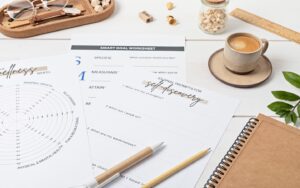
1. Start with a Circle
Draw a circle and divide it into four sections (Week 1–4). You can rename them if different language feels more fitting to your experience.
2. Add a Few Words Each Day
Notice simple things such as:
-
Emotional tone
-
Energy levels
-
Sensitivity
-
What felt supportive
-
What felt difficult
Just enough to catch the pattern — not enough to feel like a task.
3. Reflect at the End of the Month
You might gently ask:
-
What felt familiar?
-
What felt different this month?
-
Were there moments when I needed more care?
-
What helped me feel grounded?
The aim isn’t to create a perfect record. It’s to build a relationship with your own rhythm.
What Women Often Discover
When women bring their mood maps into therapy, the insights are often gentle rather than dramatic:
-
“I didn’t realise how much my energy dips in the days before my period.”
-
“I can see now why certain conversations feel harder at certain times.”
-
“It’s not that I’m inconsistent — it’s that my needs change.”
These reflections aren’t about labelling yourself. They’re about understanding yourself.
A Tool for Self-Support, Not Self-Scrutiny
Some months will feel predictable. Others won’t. Both are valid.
The map simply gives you a way to stay connected to yourself — to notice the quieter shifts, to honour the days that feel heavier, and to appreciate the moments when you feel more grounded or spacious.
Awareness doesn’t fix everything. But it does create room for choice, compassion, and steadiness.
Recommended Reading
If you would like to explore cycles, mood, and body awareness further, these books and resources may be helpful:
-
In the FLO: Work with Your Menstrual Cycle and Not Against It — Alisa Vitti
-
The Hormone Diaries — Hannah Witton
A Gentle Disclaimer
This blog is intended for self-reflection and emotional insight. It does not replace personalised therapeutic or medical care. If anything you read brings up concerns or difficult feelings, speaking with a qualified professional can be an important step.
Any suggested books or resources are offered as general recommendations and reflect personal opinion, not formal endorsement.